
WeChat E-commerce: $250 Billion in Transactions

As WeChat marks its tenth anniversary, the social networking platform is continuing to expand its capabilities in the realm of online shopping. The Chinese messaging service processed 1.6 trillion yuan – approximately $250 billion – in yearly transactions through its “mini programs,” which are third-party applications integrated within the super app, enabling users to purchase items, order meals, book transportation, and access a variety of other services.
This figure represents a doubling of transaction volume on WeChat’s mini programs compared to 2019, as revealed during the company’s annual conference for business partners and ecosystem developers. Traditionally held in Guangzhou, China, the event was conducted virtually this year in response to the ongoing pandemic.
For comparison, Pinduoduo, a rising e-commerce competitor to Alibaba, reported total transactions of $214.7 billion during the third quarter.
WeChat first introduced mini programs in early 2017, a move that some viewed as a response to Apple’s App Store. Over time, the platform has evolved into a comprehensive online infrastructure supporting many aspects of daily life. While the exact number of third-party lite apps currently available hasn’t been recently publicized, it had already reached one million by 2018, equivalent to half the size of the App Store at that time.
From a strategic standpoint for Tencent, the growth in transactions facilitated by mini programs supports the company’s objective of bolstering its financial technology sector, with digital payments serving as a key source of revenue.
A significant portion of WeChat’s mini programs consist of games, which the platform reports have attracted over 500 million monthly users. This growth is attributed to increased engagement from female and middle-aged users, as well as players located in China’s Tier 3 cities, according to WeChat.
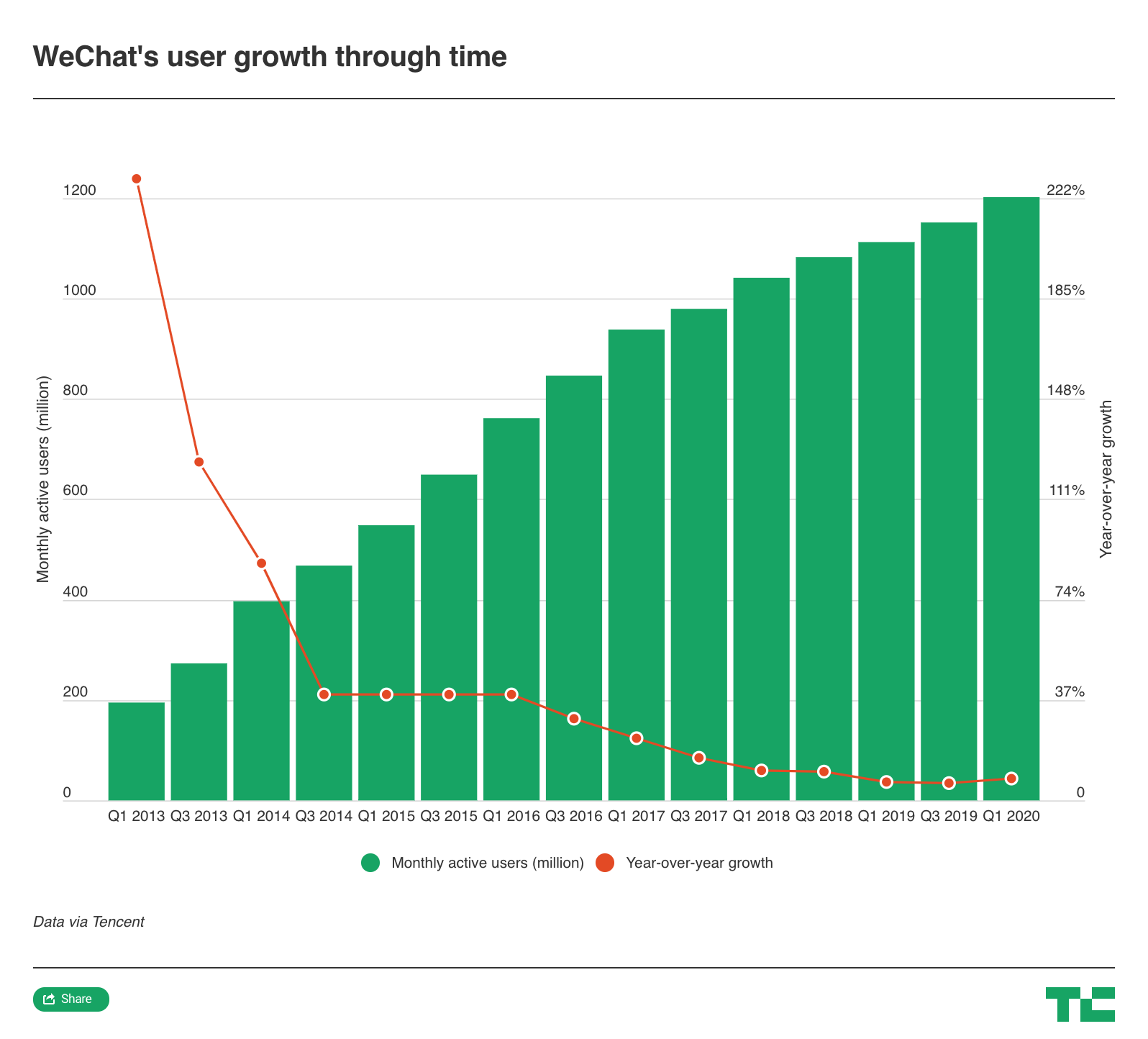
The virtual conference also highlighted several other achievements of China’s leading messaging application, which has exceeded 1.2 billion monthly active users.
Approximately 500 million users each month utilize the WeChat Search function. China’s internet landscape is characterized by several distinct ecosystems, overseen by major companies such as Tencent, Alibaba, and ByteDance, which frequently restrict access between their services. When users conduct searches within WeChat, the results primarily consist of content published on the messaging platform itself, along with information from Tencent’s partners, including Sogou, Pinduoduo, and Zhihu, rather than from the broader web.
WeChat reported that 240 million individuals have adopted its “payments score” system. When initially launched in 2019, there was speculation that this feature could indicate WeChat’s involvement in consumer credit finance and integration with the government’s social credit initiative. However, WeChat reaffirmed during this year’s event that it does not intend to pursue either of those avenues.
Similar to Ant’s Sesame Score, the rating system functions as a loyalty program, “intended to foster trust between merchants and consumers.” For example, users who achieve a certain score level may be eligible to waive deposits or postpone payments when utilizing merchant services on WeChat. WeChat stated that the score has enabled users to save over $30 billion in deposit fees annually.
The active user base of WeChat’s enterprise version has surpassed 130 million. Its primary competitor, Dingtalk, operated by Alibaba, reached 155 million daily active users last March.
The day-long event culminated with the highly anticipated appearance of Allen Zhang, the creator of WeChat. Zhang dedicated considerable time to discussing WeChat’s emerging short-video functionality, which shares similarities with Snap’s Stories. He refrained from disclosing the performance metrics of short videos, stating that “the public relations team doesn’t permit” him to do so, but expressed confidence that “if we establish a goal, we will accomplish it.”
Zhang also announced that the WeChat team is considering the development of an input tool for users. While a relatively small project given Tencent’s overall scale, it reflects Zhang’s commitment to “privacy protection,” despite existing public concerns regarding WeChat’s handling of user data.
“Analyzing [users’ chat history] could generate substantial advertising revenue for the company. However, we choose not to do so, demonstrating WeChat’s strong focus on user privacy,” Zhang explained.
“However, why do you still encounter advertisements [related to] topics you’ve discussed on WeChat? There are numerous other channels that process your information, not solely WeChat. Consequently, our technical team proposed, ‘Why don’t we develop an input tool ourselves?’ ”
Related Posts

Peripheral Labs: Self-Driving Car Sensors Enhance Sports Fan Experience

YouTube Disputes Billboard Music Charts Data Usage

Oscars to Stream Exclusively on YouTube Starting in 2029

Warner Bros. Discovery Rejects Paramount Bid, Calls Offer 'Illusory'

WikiFlix: Netflix as it Might Have Been in 1923
