
Raspberry Pi Compute Module 4 Launched for Industrial Applications

Today, the Raspberry Pi Foundation is announcing the release of their latest product – the Compute Module 4. Those following Raspberry Pi developments will recall the launch of the Raspberry Pi 4 in June 2019. The Compute Module 4 incorporates the same processing capabilities, but is designed as a compute module specifically for applications within industry.
A standard Raspberry Pi is a single-board computer characterized by numerous ports. Compute Modules differ in that they are more condensed, system-on-module boards lacking the conventional array of ports.
This allows for initial prototyping with a standard Raspberry Pi, followed by ordering Compute Modules for integration into your finished commercial products. According to Eben Upton, writing on the Raspberry Pi blog, “more than half of the seven million Raspberry Pi units we sell annually are utilized in industrial and commercial settings, including digital signage, thin clients, and process automation.”
The Raspberry Pi 4 and the Compute Module 4 share key similarities, notably the 64-bit ARM-based processor paired with VideoCore VI graphics. This represents a significant advancement for those currently using previous Compute Module versions.
Specifically, improvements include enhanced video capabilities, offering 4Kp60 hardware decoding for H.265 videos, 1080p60 hardware decoding for H.264 videos, and 1080p30 hardware encoding of H.264 videos. Furthermore, the dual HDMI interfaces enable connection of up to two 4K displays operating at 60 frames per second.
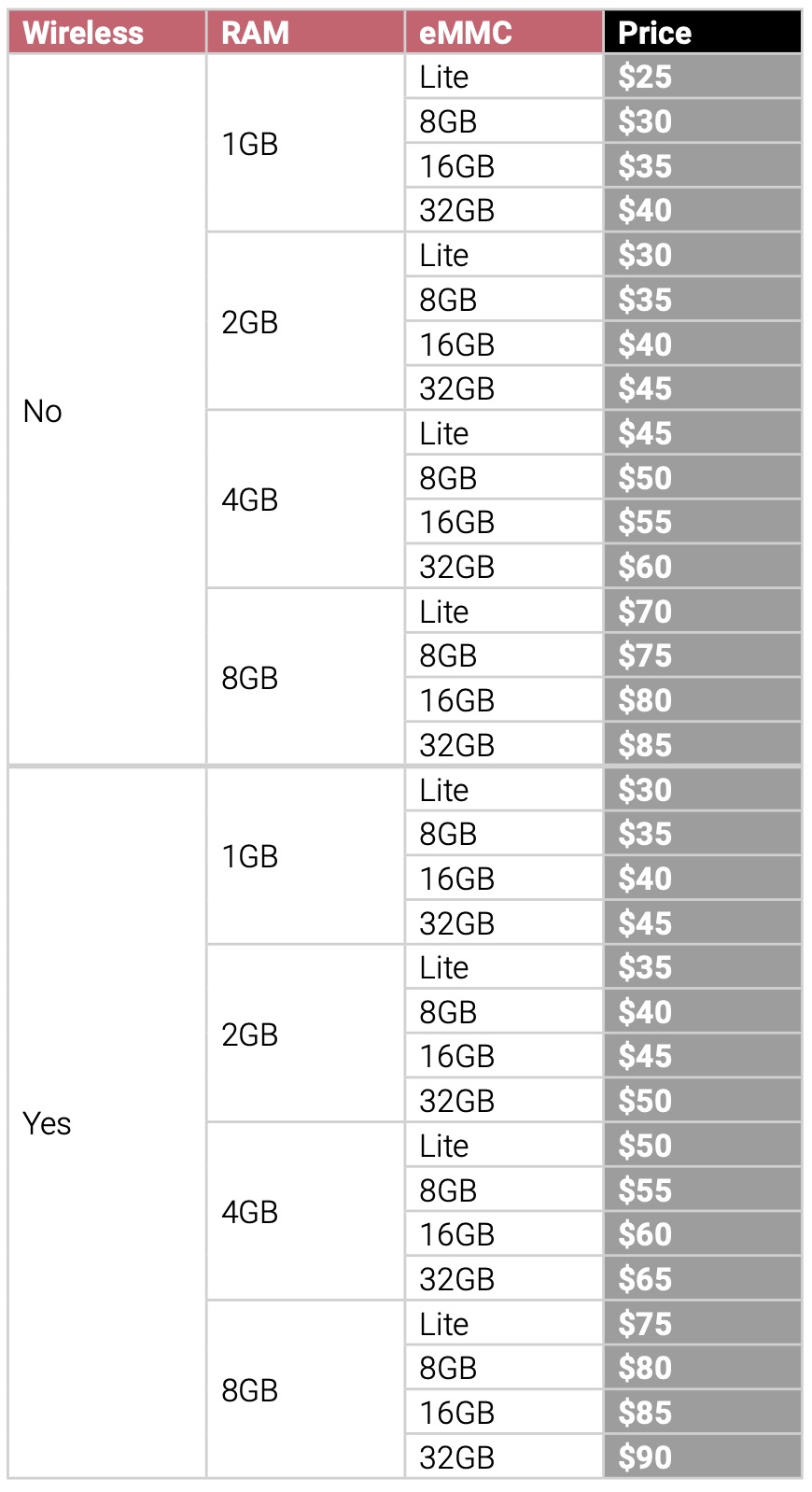
A substantial change with the Compute Module 4 is the extensive range of available configurations. You can select modules with or without wireless connectivity (Wi-Fi and Bluetooth), and choose from RAM options of 1GB, 2GB, 4GB, or 8GB. Storage options include 8GB, 16GB, or 32GB of eMMC flash storage. A version without eMMC flash storage is also available for those preferring external eMMC or an SD card interface.
These specifications can be combined to optimize costs for large-scale deployments. Consequently, there are 32 distinct versions of the Compute Module 4, priced from $25 (no wireless, 1GB of RAM, “Lite” eMMC) to $90 (wireless, 8GB of RAM, 32GB of eMMC).
The physical form factor has been updated from the previous Compute Module, meaning a new Compute Module IO Board is required to utilize all interfaces and begin development. This board is available for $35.

Related Posts

Pickle Robot Appoints Tesla Veteran as First CFO

Meta Pauses Horizon OS Sharing with Third-Party Headsets

Amazon Reportedly in Talks for $10B OpenAI Investment

Meta AI Glasses Enhance Hearing - New Feature

Whole Foods to Implement Smart Waste Bins from Mill | 2027
