
Digital Ops Toolbox: Streamline Processes with Hyperautomation

The Shift Towards Comprehensive Digital Operations
Depending on just one technology to maintain critical functions is no longer a viable strategy. When basic automation proves insufficient, achieving complete automation requires integrating a variety of technologies to revitalize business workflows – this integrated approach is known as the digital operations toolbox.
Research conducted by McKinsey indicates that organizations successfully implementing digital transformation have embraced advanced technologies like artificial intelligence, the Internet of Things, and machine learning. Hyperautomation can be realized through the digital ops toolbox, serving as the central point for all digital operations.
Components of the Digital Operations Toolbox
This toolbox represents a coordinated suite of technologies. It includes intelligent business process management (iBPM), robotic process automation (RPA), process mining, low-code development platforms, artificial intelligence (AI), machine learning (ML), and a rules engine.
These technologies, when strategically combined, enable organizations to optimize performance and achieve key performance indicators (KPIs) through hyperautomation.
The Growing Hyperautomation Market
The market for hyperautomation is experiencing significant growth. Industry analysts forecast that its value will reach approximately $860 billion by the year 2025.
This expansion is driven by the increasing need for businesses to streamline operations and improve efficiency in a rapidly evolving digital landscape.
Here's a breakdown of key technologies:
- iBPM: Manages complex business processes intelligently.
- RPA: Automates repetitive tasks.
- Process Mining: Discovers and analyzes existing processes.
- AI & ML: Enables intelligent decision-making and learning.
Understanding the Role of a Digital Operations Toolbox
A digital operations toolbox represents a collection of technologies designed to address three key areas: the automation of processes, their orchestration, and the incorporation of intelligence.
Process automation involves adopting a hyperautomation approach, aiming to automate any task or process feasible for technological handling. Utilizing bots and similar technologies for repeatable actions is a core tenet of this strategy.
Orchestration builds upon basic automation by adding a coordinating layer. Intelligent business process management suites, for example, are capable of managing entire workflows from start to finish.
While machines excel at repetitive tasks, they inherently lack human-level decision-making abilities. To bridge this gap and enable machines to “think” and operate with cognitive skills, the integration of AI is essential.
The synergy of Artificial Intelligence, Machine Learning, and Natural Language Processing, coupled with robust analytics, elevates simple automation to a more cognitive level. This allows systems to move beyond rigid if-then rules and instead derive valuable insights from data.
Consequently, bots are empowered with the capacity to make informed decisions, rather than merely executing pre-defined instructions.
Simple Automation Compared to Hyperautomation
The progression from simple automation to hyperautomation can be illustrated through a common business process: order-to-cash.
 Traditionally, the order-to-cash cycle necessitates significant coordination between departments such as sales, inventory control, order fulfillment, and finance. Simple robotic process automation (RPA) often focuses on automating isolated tasks. This might involve bots searching for invoices in emails or handling routine duties like inventory updates and payment gathering.
However, these systems typically operate in silos, lacking communication between teams and the technologies themselves.
In contrast, a hyperautomation strategy transforms the process into a seamlessly automated workflow leveraging advanced technologies. A comprehensive digital operations toolbox can reduce a twelve-step manual process down to just two steps requiring human intervention.
Examining the Order-to-Cash Example
The conventional order-to-cash process is known for being both time-consuming and labor-intensive. Manual invoice data review is prone to human inaccuracies.
Intelligent document processing accelerates this stage, and the use of intelligent bots minimizes the potential for errors. Human involvement is then concentrated on tasks like packaging, shipping, and handling exceptions.
The integration of technologies like business process management (BPM), RPA, and intelligent document processing creates a streamlined and transparent process. All teams maintain real-time visibility into the workflow’s status.
- This enhanced transparency fosters better collaboration.
- It allows for quicker identification and resolution of bottlenecks.
- Ultimately, it leads to improved efficiency and reduced costs.
Hyperautomation isn’t simply about automating more tasks; it’s about intelligently automating end-to-end processes for optimal business outcomes.
Exploring the Digital Operations Toolkit for Hyperautomation
 Intelligent Business Process Management (iBPM) represents an evolved iteration of traditional Business Process Management. It offers a more streamlined and sophisticated approach, moving beyond the complexities of extensive coding and intensive manual data interpretation.
The core aim of iBPM is to address the limitations of its predecessor by integrating technologies such as machine learning, big data analytics, and cloud computing. This integration enhances data analysis, decision-making processes, workflow management, and business monitoring, ultimately driving efficiency gains at an accelerated pace and reduced cost.
Robotic Process Automation (RPA) empowers organizations to automate repetitive, time-intensive tasks. These include data input, email handling, web data extraction, and the complete processing of customer orders. Software robots function as valuable digital assistants to employees.
Process Mining involves extracting valuable insights from existing data sources like enterprise resource planning systems, spreadsheets, databases, and bespoke software applications. This data, contained within event logs, is then visualized as workflows.
This visualization allows for the discovery, monitoring, analysis, comparison, and optimization of current processes. Process mining provides a factual, comprehensive understanding of operations, facilitating continuous improvement, increased transparency, and enhanced visibility.
Its applications span across diverse business areas, including sales, IT services, finance, auditing, and logistics.
Low-Code Development is revolutionizing application development. Predictions suggest it will account for over 65% of all software development by 2024, making it a crucial component of digital transformation initiatives.
Essentially, low-code represents a modern software development methodology that minimizes the need for traditional coding. Platforms utilize intuitive visual interfaces, drag-and-drop functionality, and reusable components and templates. Need a custom application to respond to shifting market dynamics? It can be developed in a matter of weeks.
Machine Learning (ML) algorithms are designed to mimic human learning processes, analyzing historical data to refine accuracy and improve future predictions. A prime example is speech recognition technology, which converts spoken language into text.
Consider voice assistants on smartphones and laptops, which respond to verbal commands like scheduling meetings or printing invoices. ML is increasingly utilized across industries for applications such as medical diagnosis, image analysis, prediction, and classification.
Artificial Intelligence (AI) has significantly simplified and enhanced our daily lives. Online shopping platforms suggest products based on individual preferences, autocorrect features correct typos in documents, and map applications provide optimal routes based on real-time traffic conditions.
AI enables machines to simulate human intelligence. AI algorithms emulate the human cognitive process, performing tasks through data analysis, decision-making, problem-solving, prediction, learning, and adaptation.
Rules Engines are fundamental to creating customer-focused infrastructures that enable instant, personalized, and targeted decision-making. A business rule engine serves as a centralized repository for rules, automating complex processes based on predefined criteria.
For instance, online retailers utilize rules engines to determine customer eligibility for free shipping or additional discounts. Organizations leverage BRE to maintain agility in response to market changes, comply with evolving regulations, and improve the efficiency of their decision-making processes.
Implementing a Digital Operations Toolbox: Key Best Practices
Engaging Business Users and Stakeholders: Have hyperautomation investments failed to deliver the anticipated return? A potential cause lies in the imposition of less-than-optimal technologies from the digital ops toolbox onto existing processes. Contemporary business processes are frequently fragmented across organizations, necessitating redesign, streamlining, and the elimination of inconsistencies.
A common reason for unmet expectations is a disconnect between stakeholder hopes and actual outcomes. Conduct comprehensive sessions with your teams to explain hyperautomation and the digital ops toolbox, clarifying their roles within this automation initiative. With engaged and informed business users, discussions regarding process mining, mapping, and requirements gathering become significantly more productive.
Greater understanding from users leads to the identification of more pain points and bottlenecks. It’s crucial to assess the suitability of processes for hyperautomation, directing teams towards qualified processes and prioritizing them for optimal budget allocation.
Developing a Robust Business Case and Ensuring:
- The proposed solution directly supports business objectives and the overall enterprise technology strategy.
- The project scope is formally approved, documented, and actively managed.
- Project expectations are both realistic and consistently maintained.
- The project team possesses the necessary skills and resources.
- The chosen approach is proven, reliable, and readily scalable.
- Communication remains effective and ongoing throughout the project lifecycle.
- Executive sponsorship is demonstrably strong and visible.
- The implemented system is sustainable for the customer in the long term.
A well-defined business case is essential to justify the costs associated with implementing change.
Selecting the Appropriate Technologies for Investment: The digital ops toolbox comprises over 100 different technologies. However, selecting the correct tools is vital for a successful hyperautomation journey. After defining optimized process flows and solidifying requirements, categorize those requirements based on factors such as:
- Vendor capabilities: including market presence, leadership position, and market share.
- Product capabilities: ideally, a single toolbox that addresses all technology needs.
- Financial considerations: encompassing total cost of ownership, licensing fees, maintenance, and support costs.
- Platform support: compatibility with existing OS, hardware, databases, and enterprise architecture.
- Strategic and business alignment: industry experience, relevant domain frameworks, and pre-built content.
- Usability and performance: focusing on quality, performance, scalability, multilingual support, and low-code/no-code features.
- Prioritize a minimum viable product for initial implementation, utilizing iBPM as the foundation for any hyperautomation initiative.
An agile methodology is particularly well-suited to this approach.
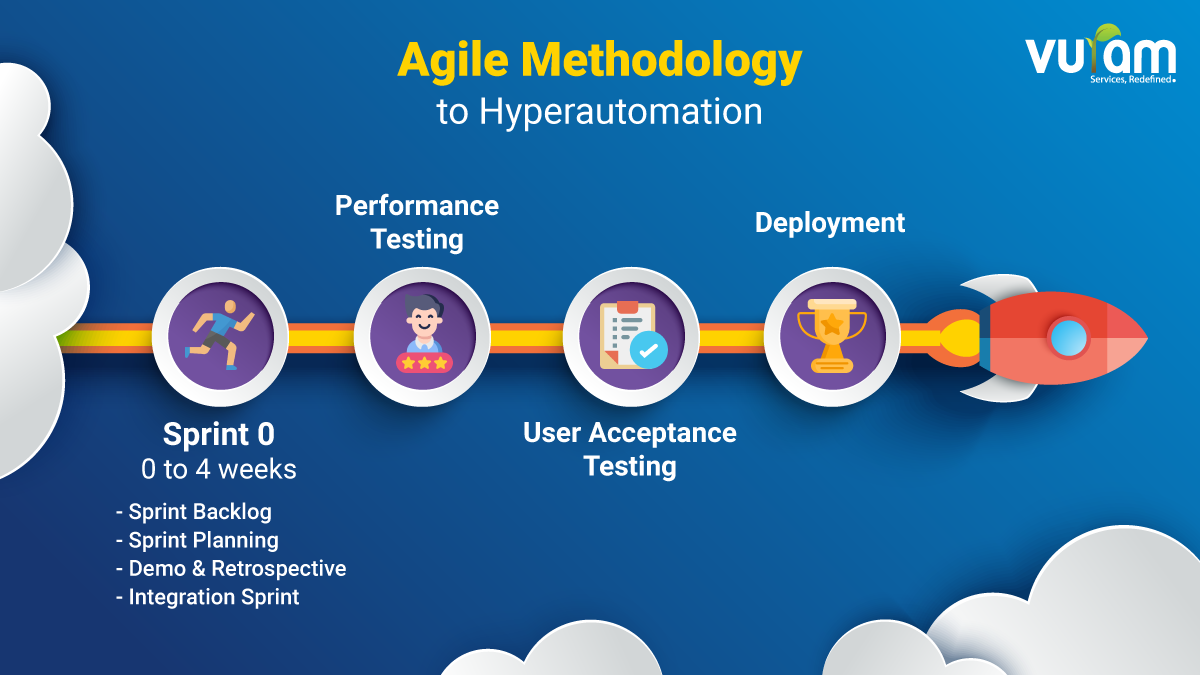
Image Credits: Vuram
Implement technologies incrementally, showcasing the differences between current ("as-is") and future ("to-be") processes through demonstrations to stakeholders. Once stakeholders recognize the potential for improvement, new requirements may emerge rapidly. Effective stakeholder management and scope control are crucial during this phase.
Evaluating the Advantages Realized
Upon full deployment, a thorough evaluation of the benefits obtained should be conducted on a quarterly basis. This assessment will help to ascertain several key factors.
- What concrete and abstract advantages have been realized?
- How can the necessity for hyperautomation be effectively advocated for within the organization?
- Were the established Key Performance Indicators (KPIs) successfully achieved?
- What additional refinements and optimizations are possible?
A representative illustration of pre- and post-implementation metrics for an insurance sector client, specifically concerning their endorsements and renewals operations, is provided below.
 Hyperautomation has the potential to fundamentally transform existing business processes. However, its implementation invariably necessitates significant organizational change management.
Proactive change management is crucial for realizing the anticipated business benefits identified during the initial planning stages.
These changes might involve departmental consolidation or the reallocation of personnel, potentially reducing headcount in one area while expanding responsibilities in another. The specific adjustments will vary depending on the organization’s pre-existing structure and operational model. Following these best practices should help guide your hyperautomation initiative.