
US Tech Giants Lead EU Lobbying Efforts - $100M+ Spend

Tech Industry Lobbying Spend in the EU Reaches €97 Million Annually
A recently published report by Corporate Europe Observatory and LobbyControl details the substantial financial investment made by the tech sector to influence the European Union’s technology policy agenda. The findings reveal that hundreds of companies, groups, and business associations collectively expend approximately €97 million (~$115 million) each year on lobbying EU institutions.
This level of expenditure establishes tech as the largest lobbying sector within the region, surpassing industries such as pharmaceuticals, fossil fuels, finance, and chemicals, according to the report from the two lobbying transparency organizations.
Key EU Digital Legislation Under Consideration
The EU is currently developing a series of significant digital laws. These include the Digital Markets Act, designed to proactively regulate major “gatekeeper” platforms to foster fair competition by prohibiting anti-competitive practices. Additionally, the Digital Services Act aims to enhance obligations for a wide range of digital businesses, particularly larger platforms, to align online regulations with those existing offline, concerning areas like illegal content and products.
Lawmakers based in Brussels are also focusing on addressing online disinformation and potential threats to democratic processes. This includes updates to the EU’s regulations governing online political advertising and stricter control over online ad targeting practices.
Furthermore, the EU is progressing towards an agreement on a risk-based framework for the implementation of artificial intelligence applications.
Data reuse represents another crucial area of regulatory attention for the EU.
GDPR Enforcement and Tech Giant Influence
The enforcement of the EU’s existing data protection regulations, the General Data Protection Regulation (GDPR), is also a key area where tech companies may seek to shape regional policy. Widespread and consistent enforcement of GDPR could potentially jeopardize the surveillance-based business models employed by online advertising giants like Google and Facebook.
Currently, numerous GDPR complaints filed against these companies remain unresolved and are pending review by Ireland’s Data Protection Commission.
Dominance of Tech Giants in EU Lobbying
The report indicates that a small number of dominant tech companies are responsible for a significant portion of EU lobbying efforts. Specifically, 10 companies account for nearly one-third of the total spending – these include Google, Facebook, Microsoft, Apple, Huawei, Amazon, IBM, Intel, Qualcomm, and Vodafone, collectively investing over €32 million annually to influence EU tech policy.
Google leads the list of Big Tech spenders in the EU, allocating €5.8 million annually to influence EU institutions, as per the report. Facebook follows with €5.5 million, Microsoft with €5.3 million, Apple with €3.5 million, and Huawei with €3 million.
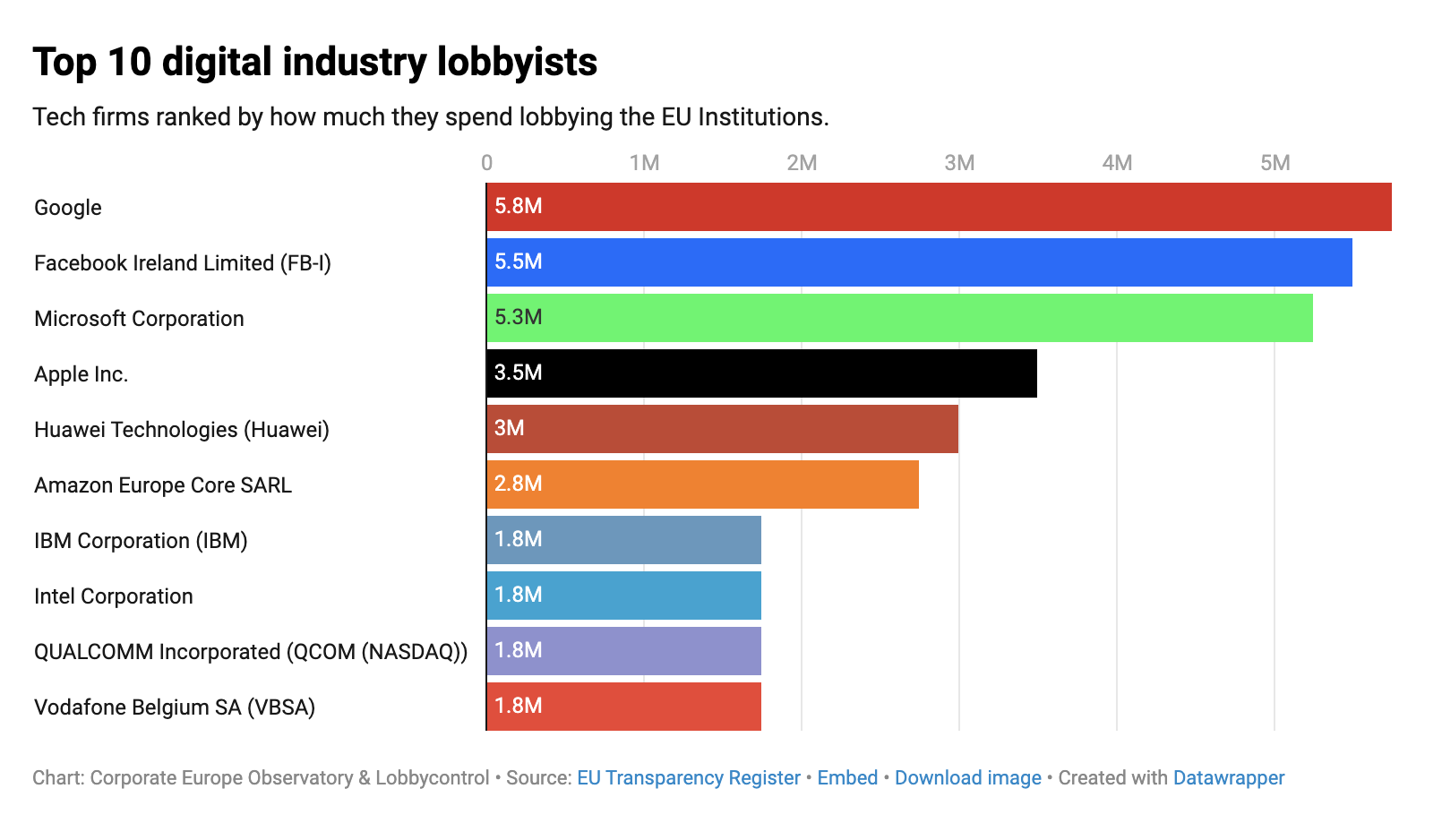
The report also notes that U.S.-based tech companies largely dominate lobbying activities within the EU, representing approximately one-fifth of the companies lobbying on digital policy. The actual proportion is believed to be even greater.
Conversely, companies based in China or Hong Kong account for less than 1% of the total lobbying expenditure, indicating a significantly lower level of investment in EU lobbying compared to their U.S. counterparts.
Industry Reliance on Astroturfing and Business Associations
The report highlights the tech industry’s frequent use of astroturfing – creating a false impression of widespread grassroots support for a policy – to advance its interests. Tech companies engage in both individual lobbying and collective organization through business and trade associations, which the report identifies as “important lobby actors”.
The lobbying budget of business associations representing Big Tech surpasses that of 75% of the companies within the digital industry.
This structure allows the wealthiest tech giants to promote preferred policy positions while appearing to represent broader industry consensus, achieved through funding these associations.
“Big Tech’s lobbying also relies on its funding of a wide network of third parties, including think tanks, SME and startup associations and law and economic consultancies to push through its messages,” the report states. “These links are often not disclosed, obfuscating potential biases and conflicts of interest.”
The report identifies 14 think tanks and NGOs with “close ties” to Big Tech firms.
Some of these organizations have actively participated in discussions surrounding the Digital Services Act, hosting exclusive debates or publishing reports that may be biased due to their funding sources.
A lack of transparency exists regarding Big Tech’s funding of think tanks, with disclosures often occurring only after external pressure. Furthermore, funding of SME and startup associations, and undisclosed client relationships of legal and economic experts participating in policy discussions, contribute to the opacity.
Think Tanks and NGOs Linked to Big Tech
The following think tanks and NGOs are linked to Big Tech backers: CERRE, CDI, EPC, CEPS, CER, Bruegel, Lisbon Council, CDT, TPN, Friends of Europe, ECIPE, European Youth Forum, German Marshall Fund and the Wilfried Martens Centre for European Studies.
Responses from Tech Giants and the European Commission
The biggest spending tech giants were contacted for comment regarding the report.
Update: A Google spokesperson provided a statement:
Microsoft also issued a statement:
The European Commission was also contacted for comment.
A Commission spokesman stated: “The criticism misses the point that the EU is regulating tech, faster and more thoroughly than any other democratic part of the world — first with the GDPR, and now with our DSA / DMA proposals, as well as with our proposals on AI and data.”
“Also when it comes to transparency, the Commission has been uncompromising in delivering the highest standards of transparency — on who we meet and on who seeks to influence us. We have led by example and have been applying the “no registration, no meeting” rule for years now. This means that only those singed up to the Transparency Register can meet with our key decision-makers. Information those meetings is published online and available for anyone to have a look.”
“The Commission is open to meeting anyone who wishes to speak to us,” he added. “The Commission does not, and will not control who requests meetings, nor how often. It is also not for the Commission to explain or comment on lobbying strategies of the different companies and interest representatives.”
The Commission spokesman also highlighted the outreach process for the DSA and DMA proposals, noting the public consultation received nearly 3,000 responses, including 2,000 from citizens. The Commission actively engaged with civil society actors, NGOs, and consumer organizations throughout the process, adhering to Better Regulation guidelines.
The full report – entitled “The Lobby Network: Big Tech’s Web of Influence in the EU” – can be found here.


