
US Election Results & Misinformation on Social Media

Early Wednesday morning statements from President Trump signaled the emergence of a widely anticipated, yet unsettling, election outcome.
“This is a fraud upon the American public,” Trump stated from the White House, blending his campaign activities with his presidential duties. “We were preparing to win this election. In fact, we did win this election.”
The President’s assertion of victory is inaccurate – vote tabulation is still in progress in a tightly contested race – but it indicated his campaign’s intent to leverage the network of misinformation they have developed over the past four years. Their current approach aligns with previously expressed plans: to focus on the later counts of ballots submitted by mail, which were projected to benefit Democrats, and to create a narrative of conspiracy.
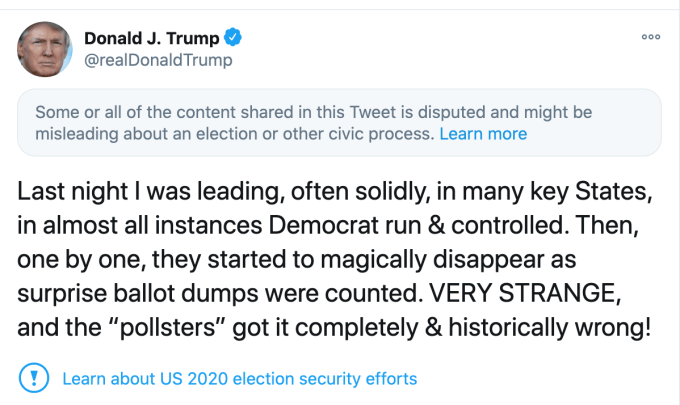
On Wednesday, Twitter applied warning labels to three of the President’s recent five tweets, indicating that the content was “disputed and potentially misleading.” The President recently tweeted, “They are working hard to make up 500,000 vote advantage in Pennsylvania disappear — ASAP. Likewise, Michigan and others!”
Update – 1:15 PM PT: Twitter appended labels to several tweets from individuals connected to President Trump, including the campaign account @TeamTrump, Eric Trump, and White House Press Secretary Kayleigh McEnany, stating that votes were still being tallied. These tweets asserted victory in Pennsylvania, a crucial state for securing an electoral win. As vote counting continues as anticipated, Pennsylvania has not yet been projected for either candidate. These posts on Twitter were not hidden or restricted as previous inaccurate election claims from the President had been.
In a separate communication, the President bypassed engagement restrictions on a previous tweet, sharing it with his own followers where it was retweeted over 32,000 times. The original author of that tweet issued a correction regarding earlier, unsubstantiated claims about Michigan’s Democratic vote count, but the initial message had already widely circulated.
The Trump campaign’s unfounded concerns regarding the validity of ballots submitted by mail began prior to the election. In September, a campaign video featured Donald Trump Jr. criticizing Democrats, whom he accused of planning to “add millions of fraudulent ballots that could invalidate your vote and overturn the election.” No evidence supported these claims at that time, nor is there any evidence now. This video, and its call for a “Trump army,” prompted Facebook to revise its policies concerning voter intimidation.
In the lead-up to the election, President Trump repeatedly refused to pledge to concede the election if defeated, a position that observers may witness unfold in the coming hours and days.
Misinformation labels were also applied to posts from Democrats, although none of those individuals are currently involved in a contested race. Twitter flagged a tweet from Center for American Progress President Neera Tanden, claiming that Biden had reached 270 electoral votes, with a disclaimer stating that the information was “disputed.”
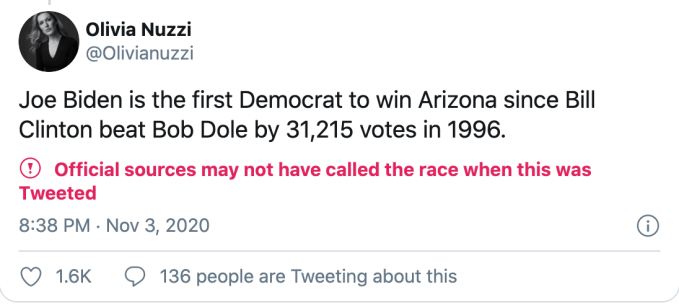
Additional warnings appeared as some states were projected by news organizations last night. After Fox News exclusively called Arizona for Biden, some political reporters tweeting about these results had their posts accompanied by a label indicating that the race had not yet been officially called.
The approaches of Facebook and Twitter differ regarding the handling of a president who frequently disseminates political misinformation. Twitter flags potentially “misleading” election-related tweets with a warning label, limits their reach by restricting replies, retweets, and likes.
Twitter discontinued political advertising entirely a year ago. While Facebook continues to permit such ads, the company implemented a temporary suspension of those advertisements after polls closed, and that suspension remains in effect.
Facebook applies its own set of “labels” to election posts that violate its rules, primarily directing users to factual, contextual information rather than issuing explicit warnings about false claims. In response to the President’s premature claims of victory, Facebook also displayed prominent messages across Facebook and Instagram reminding users that vote counting was still underway.
It is important to note that misinformation also spreads beyond Facebook, Twitter, and YouTube, circulating in less easily monitored spaces, moving between obscure online forums and mainstream social media platforms, and evolving as it spreads. Earlier Wednesday, President Trump publicly made his contested claim of victory on live television – and numerous news networks broadcast it. This is also a cause for concern.
Both Facebook and Twitter established specific policies to address a close, ambiguous election night, but the effectiveness of these rules will be tested in the coming days as concerns about political unrest and challenges to the election results intensify.


